
Commercial solar PV guidance for Yorkshire businesses, farms and schools
Home/Farms
A BrightEdge Solar guide
A farm in Yorkshire often has what a commercial solar array needs: a large shed or store roof, daytime electrical loads, and, where the roof is not suitable, a corner of land that can take a ground-mounted system.
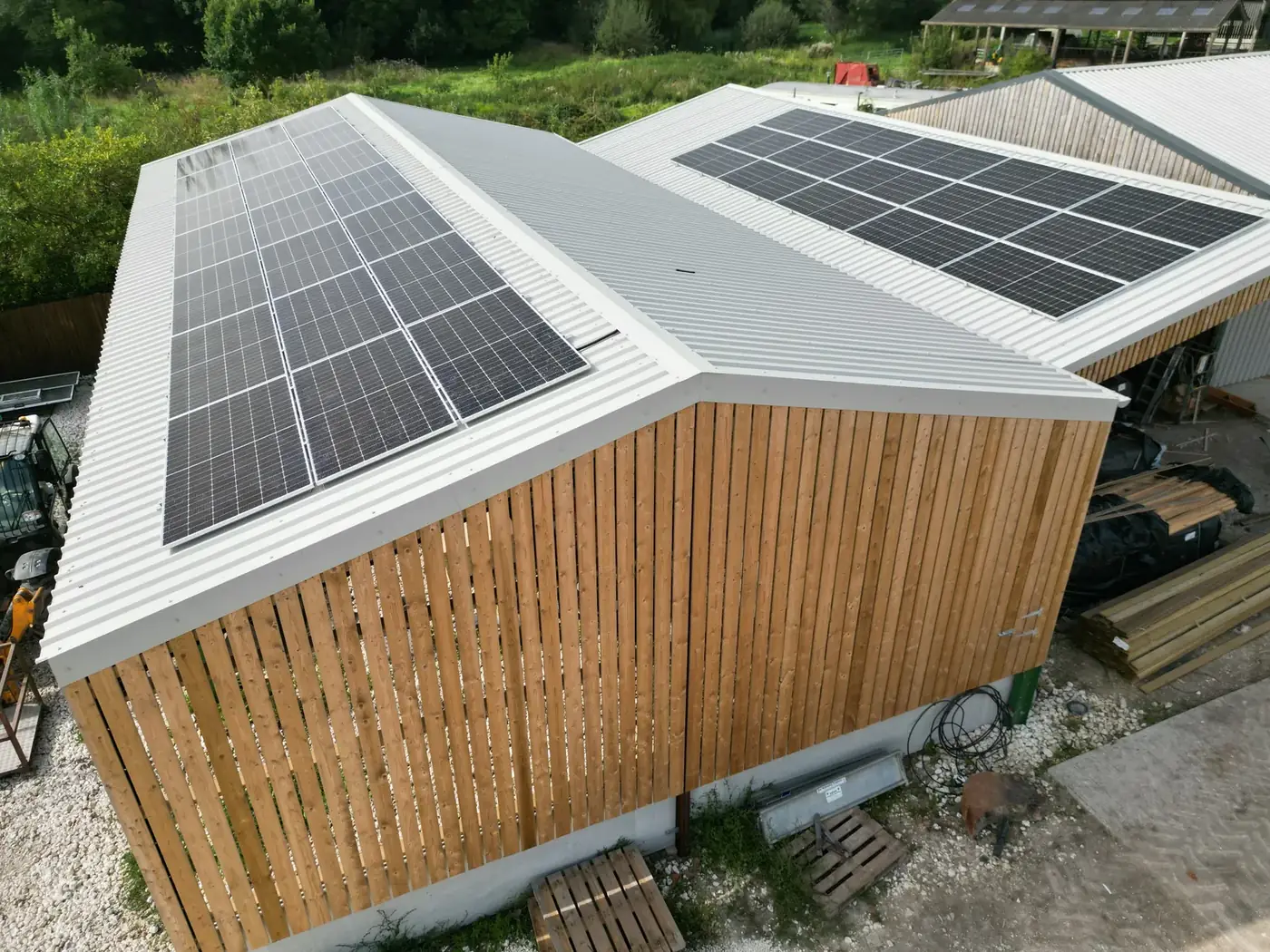
19.8 kWp
Tell us about the site and we will come back with an initial layout and estimate.
Phone is optional. An outward code is enough, for example HU17, LS12 or S9.
This page is a practical guide to those choices for agricultural buildings across the East Riding, York and North Yorkshire, West Yorkshire and South Yorkshire. It is not a national farm-solar brochure; the fuller company service page sits on BrightEdge’s main website.
Enquiries are handled by BrightEdge Solar Ltd, the MCS-certified commercial installer behind this site. Call 01482 765063 or email max@brightedgesolar.com.
Workshops, grain stores, livestock buildings, packhouses and machinery sheds often draw power while the sun is up: lighting, ventilation, refrigeration, workshop tools and the farm office. That daytime use is what usually makes a rooftop system earn its keep, because power you use on site displaces the unit rate you would otherwise pay.
The roof itself decides a lot. New or sound trapezoidal steel sheeting is typically the straightforward case. Older fibre-cement sheets need a condition check before anyone specifies fixings. Where the sheets contain asbestos, BrightEdge does not fix panels straight onto them; the usual route is to overclad the roof with new profiled sheeting and mount the array on that, as one job. If the covering is simply worn out, a re-clad first can be the sensible sequence, as at the farm store in Little Habton, North Yorkshire, where a 24.64 kWp array was fitted after new trapezoidal cladding.
If the roof is weak, shaded or already committed to something else, a ground-mounted array on land that is not being cropped can be the cleaner option. Near Pocklington, BrightEdge installed a 29 kWp array at Wapplington on ballasted ground mounts, which need no piling or concrete foundations and can be moved or extended later. Planning rules for ground-mounted systems are often tighter than for rooftop ones, so the site should be checked before anyone orders kit.
Many Yorkshire farms still have a single-phase supply. That does not rule solar out. At Ellerton, a 19.8 kWp array across two new agricultural sheds was connected through two 8 kW single-phase inverters, with a new single-phase distribution board. On three-phase farms the inverters are specified to match the supply, as with the 20 kW three-phase unit on the 19.8 kWp shed array at North Dalton.
Almost every farm system of this size needs a G99 application to Northern Powergrid before installation, because it is larger than the G98 threshold of 16 amps per phase (about 3.68 kW on a single-phase supply, or 11.04 kW on three-phase). Rural lines in the Wolds and similar areas can be limited, so the offer may cap how much you can export. In BrightEdge’s experience the application typically adds eight to twelve weeks before installation; that is their typical timescale, not an official service standard. If export is limited, the usual design responses are export limitation, or sizing the array more closely to what the farm uses on site. This guide does not set out to sell battery storage.
These are BrightEdge’s published 2026 rooftop bands, excluding VAT. They are starting bands, not a farm-specific quote. The full Yorkshire context sits on the costs and payback page.
| Rooftop size | Published 2026 band (ex VAT) |
|---|---|
| 30 kWp | £17,000–£21,000 |
| 50 kWp | £28,000–£37,000 |
| 100 kWp | £50,000–£65,000 |
| 150 kWp and above | about £420–£650 per kilowatt-peak |
Overcladding, re-cladding, ground mounting, long cable runs and trenching are priced after survey, because they vary so much between farms. VAT is charged at 20% on commercial installations; VAT-registered businesses can usually reclaim it. Figures last checked 10 November 2026.
There is no national grant that any farm can simply apply for. The former English farm-grant route is closed. Local schemes change, so they should be checked at the time of a quote. What usually matters more is tax relief. Solar panels are special-rate plant, and most sole traders and partnerships can deduct the full cost in the year of purchase through the Annual Investment Allowance, which is £1 million. That is a general summary, not tax advice; your accountant should confirm what applies. See tax relief and capital allowances.
A farm roof is not always the right starting point. A covering in poor condition that is not being replaced, a tightly constrained rural connection that would leave almost no useful export and little daytime use, or a building that sits empty for most of the working day can all make the numbers look weak. In those cases a smaller array, a ground-mounted system, or waiting until the roof is renewed may be the honest answer.
Besides Little Habton, Wapplington, Ellerton and the North Dalton shed (which also has a 22 kW EV charger for holiday-let guests), BrightEdge’s East Yorkshire commercial page records these as public examples. Full write-ups, including design estimates where they have been published, sit in the case studies on brightedgesolar.com.
Yes, but not by fixing panels to the asbestos itself. BrightEdge overclads the roof with new profiled sheeting and mounts the array on that, as one job. Modern fibre-cement roofs are assessed on their condition and can often take panels directly if they are sound.
Many rooftop systems on farm buildings can fall under permitted development, subject to conditions. Listed buildings, conservation areas, protected landscapes and ground-mounted arrays are often different. BrightEdge checks what applies to the site rather than assuming a rooftop job is automatically permitted.
Yes. The Ellerton sheds are a public example of a 19.8 kWp system on single-phase inverters. The supply still has to be surveyed, because it sets what the connection can take.
On Northern Powergrid’s Yorkshire network, BrightEdge says a G99 application typically adds eight to twelve weeks before installation, and can take longer on constrained rural lines. The official threshold is set by the Energy Networks Association’s G98 and G99 recommendations, not by a published Northern Powergrid guarantee of that timescale.
The company is based at Colonial House, Swinemoor Lane, Beverley, and covers farms across Yorkshire. See the areas page and who installs the systems.
Enquiries
Send your site address and a recent electricity bill, or half-hourly data if you have it. BrightEdge will come back with an initial layout and estimate, then arrange a survey if it is worth pursuing.
Call 01482 765063 or email max@brightedgesolar.com.
BrightEdge Solar Ltd, Beverley. MCS certified (NIC-601602). CHAS Elite. RECC. NICEIC. 24-month commercial workmanship warranty.
A four-step enquiry form. Notifications go to max@brightedgesolar.com. Phone is optional.